Modern lab and analytical instruments are expected to deliver more functions in less space — yet traditional fluid routing with long runs of tubing consumes valuable internal volume, complicates assembly, and multiplies leak risk as channel count grows. Every additional fitting, barb, and clamp in a tubing-based layout is a potential failure point, and in a densely packed instrument enclosure, chasing a single leak can mean disassembling half the fluidic subsystem.
Integrating a micro solenoid valve directly into a manifold block is the practical engineering response to this constraint. It reduces tubing length and dead volume, consolidates leak interfaces into a controlled sealing surface, and makes it possible to implement complex multi-channel flow logic inside a footprint that a tubing-based layout simply cannot match. For engineers evaluating micro miniature solenoid valves, the key question is not only valve size — it is how well the valve's porting geometry, sealing interface, and electrical characteristics support dense manifold mounting in a real instrument environment.
This article covers the working principle, manifold integration advantages, specification checklist, application fit, and total cost of ownership so your engineering and procurement teams can evaluate the transition with confidence.
The shift from tubing-based layouts to manifold-integrated valve arrays is fundamentally a change in how fluid logic is implemented — and understanding the working principle makes the engineering case clear.
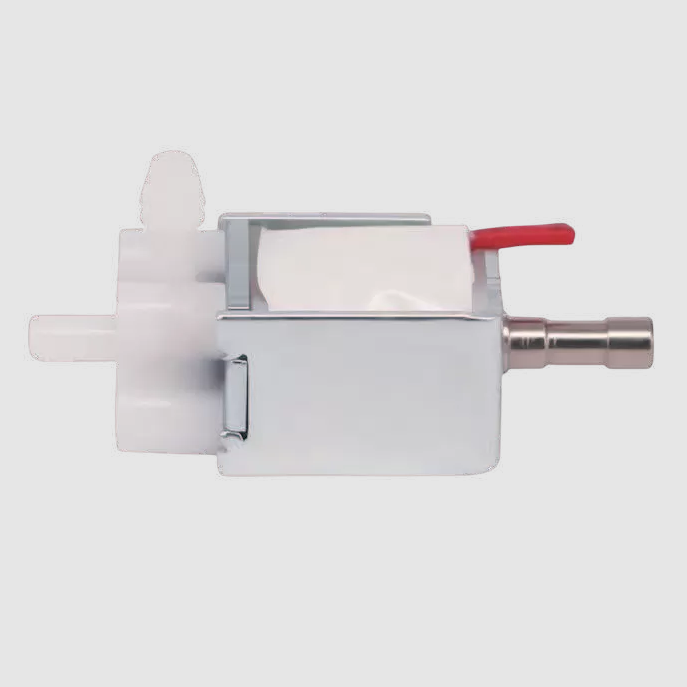
A solenoid valve converts an electrical signal into mechanical motion — energizing a coil creates a magnetic field that moves a plunger or armature to open or close a flow path. The physics of this mechanism scale favorably to small sizes: the force required to seal a small orifice is proportionally lower, the coil can be wound with fewer turns of finer wire, and the moving mass is reduced. The result is that miniaturized solenoid valves preserve the core on/off or switching control function while shrinking the actuator volume, power consumption, and response time.
For lab instruments where electrical control is already present and space is the binding constraint, this scaling behavior makes the micro water solenoid valve a natural fit for high-density fluidic control.
In a tubing-based layout, each valve connects to the next via a length of tubing, a fitting at each end, and often a clamp or tie to manage routing. As channel count increases, the number of fittings multiplies, the routing becomes increasingly complex, and the assembly time per instrument grows. Each fitting is a potential leak point, and each tubing segment adds dead volume that affects reagent consumption, carryover, and response time.
A manifold routes channels internally through machined or molded passages. The valves mount directly to the manifold surface, and the fluid path between valves is contained within the block. The external connections reduce to inlet and outlet ports — a fraction of the fittings required in a tubing layout.
The practical consequences are significant:
Fewer leak points — sealed manifold interfaces replace multiple tubing joints
Simpler routing — internal channels replace external tubing runs
More repeatable assembly — mounting a valve to a manifold port is more consistent than cutting and fitting tubing
Lower dead volume — internal passages can be designed to minimize the volume between valve seats
Manifold mounting is where the miniaturization benefit of micro miniature solenoid valves becomes most visible. The combination of small valve footprint and internal channel routing enables a level of integration density that tubing-based layouts cannot approach.
Because micro miniature solenoid valves have a small body cross-section, multiple valves can be mounted on a manifold block with a footprint measured in square centimeters rather than square decimeters. A manifold that would occupy the space of a single palm can integrate four, six, eight, or more independently controlled flow channels — each with its own valve, its own sealing interface, and its own electrical connection.
The table below illustrates how integration density changes as the approach shifts from tubing-based to manifold-mounted:
| Parameter | Tubing-Based Layout | Manifold-Integrated Array |
|---|---|---|
| External fittings per channel | 2–4 | 0–1 |
| Leak points per channel | 2–4 | 1 (manifold seal) |
| Assembly time per channel | Higher (cut, fit, clamp) | Lower (mount, torque) |
| Dead volume per channel | Higher (tubing length) | Lower (internal passage) |
| Footprint for 6 channels | Large (routing space needed) | Compact (single block) |
| Serviceability | Chase individual leaks | Replace manifold module |
A manifold-integrated valve array can implement mixing, dosing, switching, purging, and sequencing functions by combining multiple 2/2 or 3/2 valve functions on a single block. Logic that would require a network of tubing, tees, and individual valves in a traditional layout becomes a single compact subassembly with a defined inlet, outlet, and electrical connector.
This parts reduction has downstream benefits beyond the instrument itself: fewer part numbers to manage in procurement, fewer components to inspect in incoming quality control, and a simpler bill of materials for service and spare parts.
Fewer tube cuts, fewer barbed fittings, and fewer clamps translate directly into shorter assembly time per instrument and fewer opportunities for human error during assembly. In high-volume instrument production, the labor saving per unit compounds into a significant annual cost reduction.
Leak reduction is the other major benefit. In a tubing layout, leaks typically develop at fittings over time due to thermal cycling, vibration, chemical attack on the tubing material, or simple loosening. In a manifold layout, the sealing interface is an O-ring or gasket compressed against a machined surface — a more controlled and durable interface than a barbed fitting in flexible tubing.
Once tubing is minimized, the manifold sealing strategy becomes the dominant leak-prevention factor. O-ring groove dimensions, surface finish on the manifold face, O-ring material compatibility with the process media, and assembly torque specification all require careful attention. A well-designed manifold sealing interface is more reliable than tubing over the instrument's service life — but it requires more upfront engineering than simply connecting tubing.
Getting the specification right before procurement prevents costly redesigns and qualification delays. Use this checklist when evaluating micro solenoid valve options for manifold integration.
Media type: liquid or gas, and chemical compatibility with all wetted materials including valve body, seals, and manifold material
Compatibility with cleaning agents and sterilization methods used in the instrument's maintenance protocol
Operating pressure range: minimum and maximum, including any pressure spikes during switching
Target flow rate or Cv value at the operating pressure differential
Acceptable response time for the application's switching sequence
Port geometry and O-ring size: must match the manifold's sealing interface design
Mounting pattern and dimensional tolerances: affects fit-up consistency across a production run
Supply voltage and power consumption per valve: critical for thermal budget calculation in a dense array
Duty cycle: continuous energization generates more heat than intermittent switching; confirm the valve's rated duty cycle matches the application
Noise and vibration: important for benchtop instruments and sensitive measurement environments where valve actuation noise can affect results or user experience
Expected switching cycles over the instrument's service life: confirm the valve's rated cycle life meets or exceeds this requirement
Internal dead volume: critical for microfluidic applications, reagent conservation, and fast response time requirements
Performance stability over life: confirm that flow characteristics and leak rate remain within specification across the rated cycle count
In vitro diagnostic instruments require compact reagent routing, wash and purge sequences, and precise metering of small fluid volumes. Manifold-integrated micro solenoid valve arrays reduce carryover risk by minimizing dead volume between channels, simplify the reagent routing architecture, and make the fluidic subassembly easier to service in the field — replacing a manifold module rather than chasing individual tubing leaks.
Low dead volume and fast switching response are the primary requirements in sample preparation and microfluidic applications. Manifold-integrated micro miniature solenoid valves meet both requirements simultaneously: internal passages minimize dead volume, and the small moving mass of the miniaturized actuator enables fast response times. Precise metering and sequencing become more repeatable when the fluid path geometry is fixed in a manifold rather than varying with tubing routing.
Multi-stream switching for sampling and calibration routines requires compact, reliable valve arrays that can operate continuously in field-deployed instruments. Manifold integration reduces the instrument's internal volume, which is particularly valuable in portable or rack-mounted environmental monitoring equipment where enclosure size is constrained.
Denser functions per module and easier service replacement are the key benefits in lab automation applications. A standardized manifold block with a defined valve array can be replaced as a unit during service, rather than requiring a technician to diagnose and replace individual valves in a tubing-based layout. This reduces service time and the skill level required for field maintenance.
Following a structured selection process reduces the risk of discovering incompatibilities late in the development cycle, when changes are expensive.
Step 1 — Map the required fluid logic: Define the number of channels, the valve function required at each channel (2/2 normally closed, 2/2 normally open, or 3/2), and the fail-safe position for each valve in the event of power loss.
Step 2 — Define manifold constraints: Establish the available footprint, port spacing, sealing method, and manifold material based on the instrument's enclosure design and media compatibility requirements.
Step 3 — Validate the thermal budget: Calculate the total heat generated by the valve array at the expected duty cycle and confirm that the instrument enclosure's thermal management can handle it. Dense valve arrays in small enclosures can generate meaningful heat loads.
Step 4 — Prototype for performance: Build a prototype manifold assembly and validate leak rate, response time, carryover performance, and assembly repeatability before freezing the design.
Step 5 — Freeze specs and qualify suppliers: Once the design is validated, document the full specification and qualify suppliers for dimensional consistency, media compatibility, and cycle life — not just initial performance.
The TCO benefits of manifold integration are most visible in production and field service:
Fewer field failures from tubing leaks reduce warranty service events and the associated labor and parts cost. In instruments deployed in clinical or field environments, a tubing leak can require a service call — a manifold seal failure is less common and easier to diagnose.
Faster assembly reduces labor cost per instrument in production. The reduction in assembly time per unit compounds into a significant annual saving at production volumes above a few hundred instruments per year.
Easier module swap during servicing reduces the skill level and time required for field maintenance. A technician who can replace a manifold block in minutes provides a better service experience than one who must spend an hour chasing a leak in a tubing network.
Maintenance focus points for manifold-integrated systems include: seal inspection at defined service intervals, media filtration upstream of the valve array to prevent particulate contamination that can cause valve sticking, and confirmation that cleaning protocols are compatible with all wetted materials in the manifold and valve assembly.
Miniaturization in lab equipment is increasingly limited by fluid routing, not electronics. Replacing tubing-heavy layouts with manifold-integrated micro solenoid valve arrays reduces leak points, saves internal space, lowers dead volume, and makes it practical to implement complex sequencing and multi-channel logic control inside compact instrument enclosures. With the right manifold interface design, thermal plan, and media compatibility validation, micro miniature solenoid valves become a scalable and reliable building block for next-generation analyzers, microfluidic modules, and lab automation systems.
To receive a configuration matched to your instrument design and production requirements, provide the following when you submit:
Work conditions: Media type and chemical composition, temperature range, cleaning or sterilization method, duty cycle, and expected switching cycles per day.
Quantity: Prototype quantity, pilot build quantity, and annual volume forecast.
Size and spec: Available manifold footprint, port spacing, sealing method, channel count, and required valve functions at each channel.
Target metrics: Maximum allowable leak rate, response time target, flow or Cv target, allowable dead volume per channel, and power or heat dissipation limit for the valve array.
Current problem: Tubing consuming too much internal space, frequent leak failures in the field, carryover between channels, slow assembly in production, or unstable flow switching performance.
1. What is a micro solenoid valve?
A micro solenoid valve is a compact, electrically actuated valve designed to control small flows of gas or liquid. It operates by energizing a coil to generate a magnetic field that moves a plunger or armature, opening or closing a flow path. Micro solenoid valves are used in applications where space, power consumption, and precise fluid routing are constrained — including lab instruments, analytical equipment, medical devices, and microfluidic systems.
2. How do manifold-mounted valves compare with tubing-based valve connections?
Manifold mounting routes fluid channels internally through a machined or molded block, so valves mount directly to the manifold surface without external tubing between them. This reduces the number of fittings and leak points, simplifies assembly, and lowers dead volume compared with tubing-based layouts. Tubing-based layouts offer more flexibility during prototyping and are easier to modify, but as channel count grows they consume more space, add more leak points, and increase assembly time. For production instruments with a fixed fluid logic design, manifold mounting typically delivers better reliability and lower assembly cost.
3. What ROI can manifold integration deliver?
ROI comes from several compounding sources: shorter assembly time per instrument reduces production labor cost; fewer leak-related field failures reduce warranty service events and associated costs; easier module replacement during service reduces field labor time; and better production yield from fewer manual tubing operations reduces scrap and rework. The ROI is strongest when the instrument uses multiple valves, is produced in volume, and is deployed in environments where field service is expensive.
4. Do we need to redesign our instrument to switch to micro/miniature solenoid valves on a manifold?
Some redesign is typically required, primarily at the fluidic subassembly level: the manifold block, sealing interface, and mounting layout must be designed for the chosen valve's porting geometry and mounting pattern. Many development teams implement this as a modular fluidic subassembly upgrade — redesigning the manifold block while preserving the rest of the instrument architecture. This approach limits redesign scope and risk while capturing the full benefit of manifold integration.
5. What parameters should we provide to select the right valve and manifold interface?
Provide the following: media type and chemical compatibility requirements, operating pressure range and flow or Cv target, valve function required at each channel (2/2 normally closed, 2/2 normally open, or 3/2), response time requirement, duty cycle and expected cycles per day, allowable power consumption and heat dissipation per valve, manifold footprint and port spacing constraints, sealing method and O-ring material preference, maximum allowable leak rate, and expected lifetime switching cycles. This information allows the supplier to confirm valve compatibility, recommend a manifold interface design, and provide an accurate quotation.